Skip to content
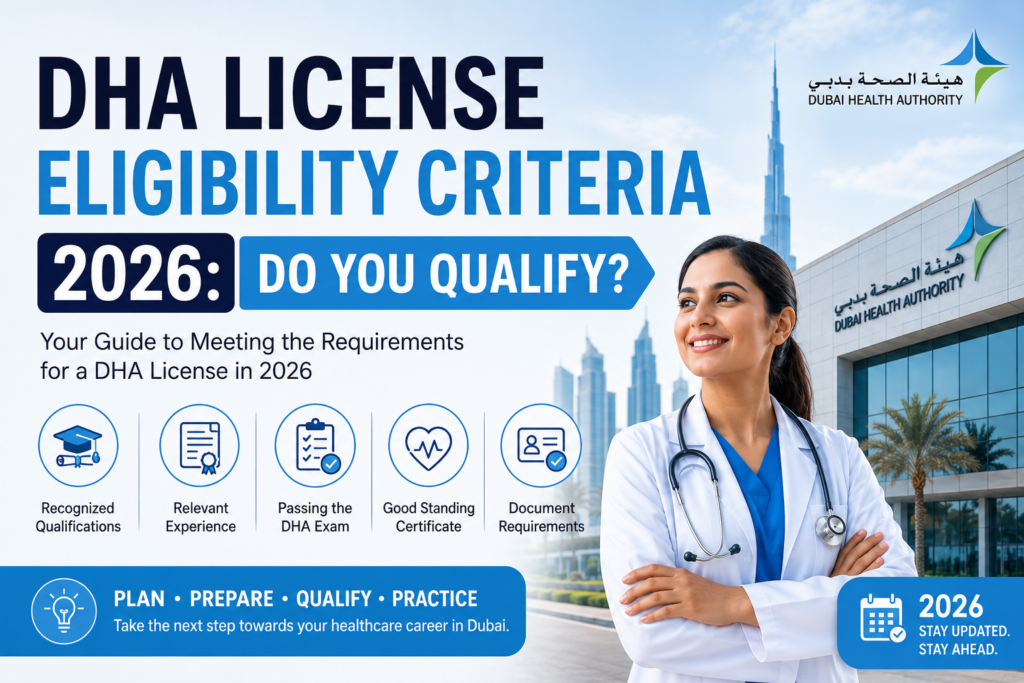
DHA License Eligibility Criteria 2026: Do You Qualify?
A complete breakdown of the Professional Qualification Requirements (PQR) for GPs, Specialists, Nurses, Pharmacists, and Allied Health Professionals — plus experience thresholds, documentation, and the DataFlow process.
In This Guide
- What Is a DHA License?
- Understanding the Professional Qualification Requirements (PQR)
- Eligibility Criteria for General Practitioners (GPs)
- Eligibility Criteria for Specialist Doctors
- Eligibility Criteria for Nurses
- Eligibility Criteria for Pharmacists
- Eligibility Criteria for Allied Health Professionals
- Complete Document Checklist for DHA License
- The DataFlow Primary Source Verification Process
- The DHA Prometric Exam: What You Need to Know
- Frequently Asked Questions
- Take the Next Step
What Is a DHA License?
A DHA License is the official professional licence issued by the Dubai Health Authority (DHA) that allows qualified healthcare professionals to legally practise in Dubai. Whether you are a doctor, nurse, dentist, pharmacist, physiotherapist, radiographer, or allied health professional, practising in DHA-regulated hospitals, clinics, medical centres, or home healthcare facilities in Dubai requires a valid DHA license.
Every year, thousands of healthcare professionals from India, Pakistan, the Philippines, Egypt, the UK, and beyond move to Dubai to build their careers in one of the world's fastest-growing healthcare sectors. However, the licensing process can be complex and varies significantly by profession. Understanding the eligibility criteria upfront can save you months of delays, rejected applications, and unnecessary costs.
This guide provides a comprehensive overview of the DHA License Eligibility Criteria for 2026, with detailed requirements for General Practitioners, Specialists, Nurses, Pharmacists, and Allied Health Professionals.
Need help with your DHA license application? Our expert consultants provide end-to-end support — from eligibility assessment to final license issuance. Explore our DHA licensing consultancy services →
Understanding the Professional Qualification Requirements (PQR)
The Professional Qualification Requirements (PQR) is the foundational regulatory framework that determines your eligibility for a DHA license. It is a unified framework jointly approved by the Ministry of Health and Prevention (MOHAP), Department of Health – Abu Dhabi (DOH), Dubai Health Authority (DHA), and Sharjah Health Authority (SHA).
The PQR establishes the minimum academic qualifications, clinical training standards, professional experience criteria, and competency benchmarks required for healthcare professionals to practise in Dubai legally. It verifies educational qualifications to ensure they meet international standards before practising in any of the seven emirates.
Key General Requirements Under PQR
| Requirement | Details |
|---|---|
| Educational Qualifications | Must be from a recognised institution; provisional certificates accepted if properly accredited |
| Internship/Training | All physicians and dentists must complete one year of internship after graduation |
| Professional Experience | Must be hands-on clinical work gained during licensed, paid employment; non-clinical or teaching experience not accepted |
| Good Standing Certificate | Must be issued within the last six months from the current licensing authority |
| Primary Source Verification | Mandatory DataFlow verification of all educational and professional credentials |
Eligibility Criteria for General Practitioners (GPs)
General Practitioners (GPs) are the frontline of primary healthcare in Dubai. Here are the complete eligibility requirements for 2026:
Educational Qualifications
- A recognised MBBS, MD, or equivalent medical qualification from a medical school listed on the Avicenna database (formerly the WHO directory of medical schools)
Internship Requirements
- Completion of a one-year rotating internship after graduation
- Important: Internship is not counted as working experience for GP applications
Clinical Experience
- Minimum of 2 years of post-internship/housejob clinical experience
- Experience must be in a general practice setting for international candidates
- Experience must be gained during licensed, paid employment (non-clinical or teaching experience is not accepted)
Professional Registration
- Valid professional registration or licence from your home country or country of last employment
- No interruption in clinical practice for more than 2 years
Good Standing Certificate
- A Good Standing Certificate (GSC) issued within the last 6 months from the current licensing authority
Key Takeaway: Fresh medical graduates should note that a formal internship completed after your medical degree counts as post-graduation experience. A one-year rotating hospital internship brings you to one year of qualifying experience; add a second year and you meet the threshold for many GP-level applications.
Eligibility Criteria for Specialist Doctors
Specialist doctors—including cardiologists, neurologists, surgeons, and other specialists—have more stringent requirements than GPs.
Educational Qualifications
- A recognised primary medical degree (MBBS, MD, or equivalent)
- A recognised postgraduate speciality degree (e.g., MD, MS, MDS, or equivalent)
- Medical school must be listed on the Avicenna database
Internship Requirements
- Completion of a one-year rotating internship after graduation
Clinical Experience
- Minimum of 3 years of post-specialisation clinical experience
- Experience must be directly relevant to the speciality being applied for
- For surgical specialties, a logbook with sufficient cases covering key procedures must be provided
- Experience must be hands-on clinical work during licensed, paid employment
Professional Registration
- Valid professional registration or licence from your home country or country of last employment
- Must have a valid practice licence in the country of graduation and/or country of last employment
- No interruption in clinical practice for more than 2 years
Key Takeaway: For specialists, the postgraduate degree and speciality training are critical. DHA evaluates your credentials against the PQR framework, which classifies countries and training systems into tiers.
Eligibility Criteria for Nurses
Nursing has seen significant regulatory changes in 2026, particularly for fresh graduates.
Educational Qualifications
- Bachelor of Science in Nursing (BSN) or equivalent four-year degree from a DHA-approved university
- Diploma-level nurses may face additional scrutiny or mandatory experience thresholds
Clinical Experience
Major 2026 Update: Under PQR Version 3, the mandatory six-month post-graduation experience requirement for nurses holding a BSN or equivalent four-year degree has been removed.
- Fresh graduates (< 24 months) no longer need work experience
- For nurses with a BSN, you can apply directly after graduation and passing your licensing board exam
Professional Registration
- Valid home-country nursing registration (e.g., Indian Nursing Council registration, PRC license for Filipino nurses)
- Must pass the DHA Prometric exam
License Validity and Renewal
- License validity is only 1 year
- Annual renewal requires 20 CME/CPD credits
Key Takeaway: 2026 is a landmark year for nursing applicants. Fresh graduates with a BSN can now pursue a DHA license without prior work experience—a significant change that opens doors for newly qualified nurses worldwide.
Eligibility Criteria for Pharmacists
Pharmacists have specific requirements that differ from both physicians and nurses.
Educational Qualifications
- Bachelor of Pharmacy (BPharm) or PharmD from an approved institution
- Important: BPharm degrees with only 3 years duration may not be accepted; a 4-year BPharm or PharmD is generally required
Clinical Experience
- Generally expects at least 1 year of post-registration experience for community pharmacy roles
- Hospital pharmacy residency programs completed post-degree are counted
- Fresh PharmD graduates without any post-degree work may face a provisional pathway
Under PQR Version 3
- Entry-grade requirements have been eased
- Requires only a recognised degree, active home registration, DataFlow Primary Source Verification, and passing the DHA exam
Key Takeaway: Pharmacists should ensure their degree duration meets DHA requirements (4 years minimum). The PQR Version 3 has made entry more accessible, but the degree length remains a critical factor.
Eligibility Criteria for Allied Health Professionals
This category includes physiotherapists, radiographers, laboratory technologists, occupational therapists, speech therapists, and other allied health roles.
Educational Qualifications
- Bachelor's degree or higher in the relevant discipline from a recognised institution
Clinical Experience
- Varied by profession—each allied health discipline has its own DHA data sheet
- Many allied health disciplines no longer require post-graduation experience for first-time applicants, provided the applicant holds a bachelor's degree or higher and passes the relevant competency exam
Key Takeaway: Allied health professionals should check the DHA Sheryan system for profession-specific requirements, as this category has the most variation.
Complete Document Checklist for DHA License
Before starting your application, prepare the following documents:
Identity Documents
- Valid passport copy (minimum 6 months validity from application date)
- Passport-size photographs—recent (within 6 months), white background, professional appearance
- Marriage certificate (if name has changed)
Educational Documents
- Educational certificates (e.g., MBBS, BDS, BSN, BPharm, Allied Health degree)
- Academic transcripts/mark sheets with official seal
- Specialty certificate/degree (e.g., MD/MS, MDS, MSc, PhD—if applying for specialist/consultant title)
Professional Documents
- Internship certificate
- Valid practice licence from country of graduation and/or country of last employment
- Evidence of all clinical experience—certificate(s) issued by the facility of practice, signed by the Human Resources Department or Medical Director
- Recent Good Standing Certificate (GSC)—issued within the last 6 months by the medical council/association from the country of last employment
- Log book (for surgical specialties only)
Additional Requirements
- Updated CV
- Malpractice insurance—required before license issuance
- Medical fitness test—for candidates aged 65 years or above
Document Formatting Guidelines
- Upload in PDF format where possible
- Colour scans required
- Clear, readable copies
- English translation required if documents are not in English
- Names must match passport exactly
The DataFlow Primary Source Verification Process
DataFlow is the mandatory Primary Source Verification (PSV) process used by DHA to verify educational qualifications, licenses, and work experience.
Who Needs DataFlow?
All healthcare professionals—including doctors, pharmacists, nurses, and allied health professionals—must undergo PSV through DataFlow as part of the licensure process.
What DataFlow Verifies
- Educational qualifications
- Professional licenses
- Work experience
- Good Standing Certificates
Cost and Timeline
- Typical cost: AED 900-1500+ (each extra document may cost AED 200-300)
- Processing time: Typically 30-45 working days
- Delays may occur in case of discrepancies
Common Issues Causing Delays
| Issue | Description |
|---|---|
| Unclear scans | Documents must be clear and readable |
| Name mismatches | Names must match passport exactly |
| Experience certificate format | Must include letterhead, official stamp, and clear timeline |
| Expired GSC | Good Standing Certificate must be valid (within 6 months) |
| Non-responsive institutions | Educational institutions or employers failing to respond to DataFlow queries |
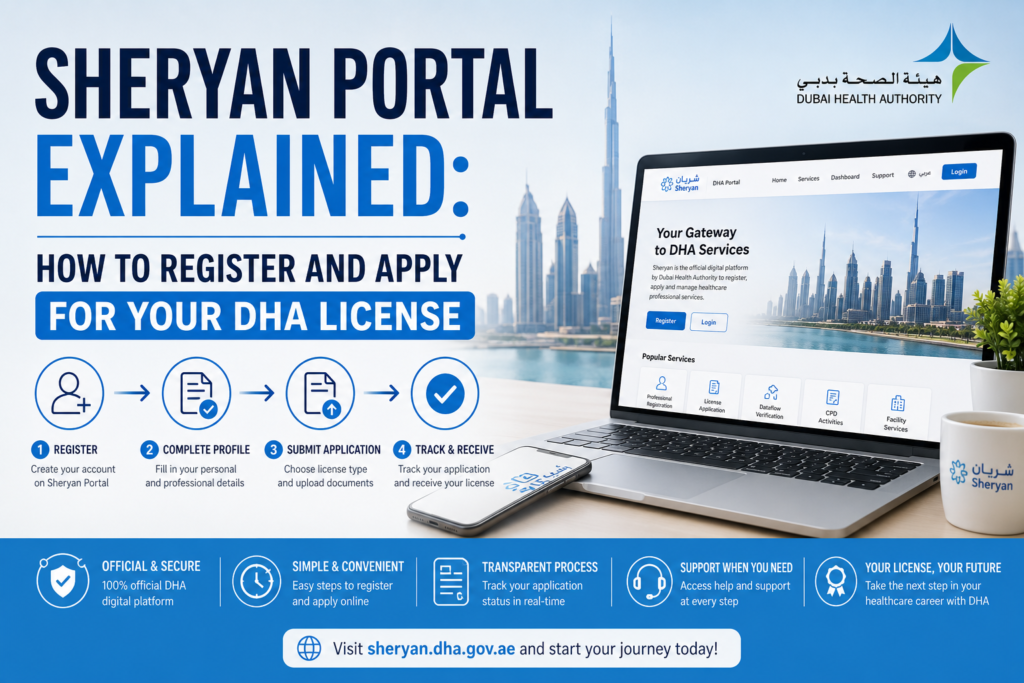
| Unlinked accounts | Sheryan and DataFlow accounts not linked |
| Degree duration issues | e.g., 3-year BPharm may not be accepted |
Note: You can use the same DataFlow report for different UAE health authorities (DOH, MOHAP) by paying an additional transfer fee.
The DHA Prometric Exam: What You Need to Know
Most healthcare professionals applying for a DHA license need to pass the Prometric computer-based test.
Exam Eligibility Requirements
| Profession | Experience Required |
|---|---|
| GP Doctors | 2 years post-internship/housejob |
| Specialists | 3 years post-specialisation |
| Nurses | At least 2 years (fresh graduates may be eligible under new rules if graduated from a recognised medical school within 2 years) |
| Pharmacists | As per PQR requirements |
Exam Details
- Pass mark: 60%
- Attempts: Up to 3 attempts allowed per application cycle
- Exemptions: May apply in certain situations
Tips to Avoid Application Delays
- Name should be exactly like the passport
- Upload documents in JPEG/PDF format only in the required fields
- Name scanned documents according to the certificate (e.g., Passport, Picture, Experience)—do not use numbers like 1, 2, 3
- For surgeons, a log book must be submitted in the experience field
- If you don't have a required document, upload a justification letter
After Passing the Exam
Once you successfully pass the exam, an eligibility letter will be issued through the online Sheryan system. This letter confirms you have completed the licensing assessment and are eligible to work in Dubai.
Important: An eligibility letter is not a license. It does not authorise you to practise independently. Once you secure employment with a DHA-approved healthcare facility, your eligibility is converted into an active DHA License.
Need expert guidance for your DHA license?
Navigating the DHA licensing process can be complex and time-consuming. Our experienced consultants provide end-to-end support — from eligibility assessment and document preparation to DataFlow verification, exam booking, and final license issuance.
Frequently Asked Questions
Can fresh graduates apply for a DHA license?
Yes. Under PQR Version 3, fresh graduates can apply for a DHA license. However, the pathway differs by profession:
- Nurses (BSN): No experience required—can apply directly after graduation
- Doctors: Minimum 2 years post-internship experience required for full licensure
- Pharmacists: Generally requires 1 year experience; fresh PharmD graduates may face a provisional pathway
What is the difference between a DHA Eligibility Letter and a DHA License?
A DHA Eligibility Letter confirms you have completed the licensing assessment and are eligible to work in Dubai. A DHA License is the official licence that authorises you to practise. You need a job offer from a DHA-approved facility to convert eligibility into an active license.
How long does the DHA licensing process take?
The timeline varies, but typically:
- DataFlow verification: 30-45 working days
- Exam preparation and scheduling: Variable
- Overall process: 2-4 months on average
Can I use the same DataFlow report for DOH or MOHAP?
Yes. You can use the same DataFlow report for different UAE health authorities by paying an additional transfer fee.
What happens if I have a career gap?
There should be no interruption in clinical practice for more than 2 years.
Is my degree recognised by DHA?
Your medical school must be listed on the Avicenna database (formerly the WHO directory of medical schools). For other professions, check the DHA Sheryan system for approved institutions.
What is the cost of getting a DHA license?
Professional-side fees commonly total approximately AED 3,000 to AED 9,000 or more, combining DataFlow fees, evaluation fees, exam fees (where applicable), and license issuance fees.
Take the Next Step
The DHA licensing process in 2026 has become more accessible than ever, particularly with the introduction of PQR Version 3, which has removed experience requirements for several categories of healthcare professionals.
Whether you are a fresh graduate nurse, an experienced GP, a specialist doctor, or a pharmacist looking to build your career in Dubai, understanding your eligibility is the first and most critical step.
Ready to begin your DHA licensing journey? Montgo Health Systems provides expert DHA license consultancy in Dubai — from eligibility assessment to final approval. Get started today →
Quick Eligibility Summary
| Profession | Minimum Qualification | Experience Required | Exam Required |
|---|---|---|---|
| GP | MBBS/MD | 2 years post-internship | Yes |
| Specialist | MBBS/MD + Postgraduate Degree | 3 years post-specialisation | Yes |
| Nurse (BSN) | BSN | None (fresh graduates eligible) | Yes |
| Pharmacist | BPharm (4-year) or PharmD | 1 year (generally) | Yes |
| Allied Health | Bachelor's degree | Varies by profession | Yes |
Common Reasons for Application Rejection
- Documents with unclear or blurry scans
- Mismatch in names across documents
- Experience certificate without proper format (letterhead, official stamp, clear timeline)
- Expired Good Standing Certificate
- Degree duration issues (e.g., 3-year BPharm)
Remember: Meeting the eligibility requirements early helps reduce processing delays later in the application. Our DHA license consultancy experts can help you avoid common pitfalls and fast-track your approval.
This article is intended for educational and informational purposes only. Licensing requirements are subject to change; please verify all information with official DHA sources or a qualified licensing consultant before beginning your application.