Montgo Health Systems

Day: February 26, 2026

  • How Do You Renew a Medical License in the UAE?

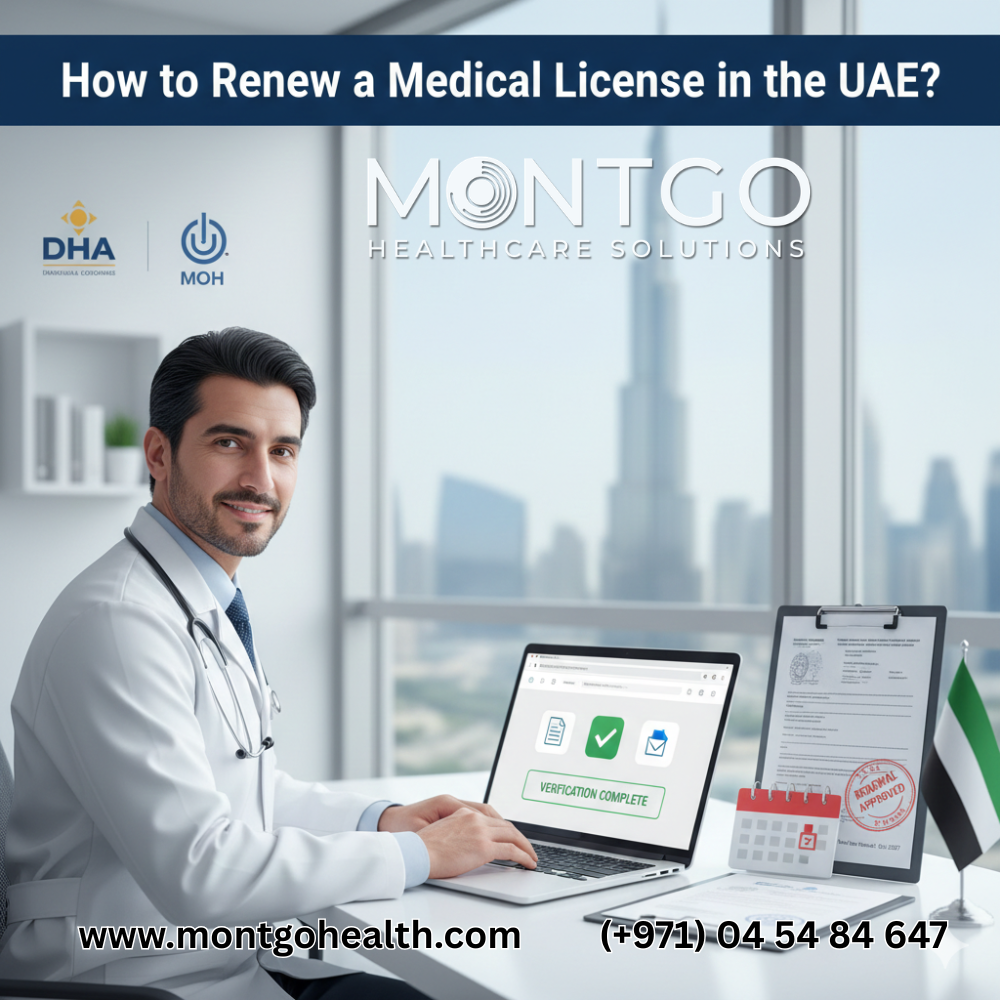
    How Do You Renew a Medical License in the UAE?

    If you’re a doctor, nurse, pharmacist, or any other healthcare professional working in the United Arab Emirates, you must keep your medical license active to continue practicing. The good news? Renewing your license is not difficult, you just need to follow the right steps.

    The process is done through the health authority you are licensed under:

    • MOHAP (Ministry of Health & Prevention)

    • DHA (Dubai Health Authority)

    • DOH Abu Dhabi (Department of Health – Abu Dhabi)

    Although each authority has its own online system, the steps are mostly similar. 

    Here’s the easy version:

    Step 1: Make Sure You Have Enough CME Hours

    CME = Continuing Medical Education.

    Every healthcare professional must complete a certain number of CME/CPD hours (training courses, conferences, workshops) before renewing.

    • Doctors usually need more hours.

    • Nurses, pharmacists, and allied health professionals need fewer.

    Make sure your CME certificates are valid and uploaded.

    Step 2: Log In to Your Health Authority Account

    Go to the online portal where your license was issued:

    • MOHAP → “eServices / Sheryan”

    • DHA → “Sheryan”

    • DOH → “TAMM / DOH Licensing System”

    Once logged in, look for “License Renewal”.

    Step 3: Upload Required Documents

    Generally, you will need:

    • Passport copy

    • Emirates ID

    • Recent photograph

    • Valid malpractice insurance

    • CME/CPD certificates

    • Good Standing Certificate (sometimes required)

    The portal will show exactly what you need.

    Step 4: Pay the Renewal Fees

    Fees vary depending on your profession and authority.
    All payments are done online through the portal.

    Step 5: Submit the Renewal Application

    After uploading everything and paying the fee, click Submit.

    Approval usually takes a few days to a couple of weeks, depending on the authority and if extra checks are needed.

    Step 6: Receive Your Renewed License

    Once approved, you can download your renewed license directly from your account. In most cases, it’s valid for one year.

    Tips to Make Renewal Easier

    • Start the process at least 1–2 months before your license expires.

    • Keep a folder of all updated CME certificates.

    • Make sure your malpractice insurance is active before applying.

    • Ensure your Good Standing Certificate (if required) is recent, usually not older than 3 months.

    When should I start the renewal process?

    You should start the renewal process 1–2 months before your medical license expires.

    This gives you enough time to:

    • Complete any remaining CME/CPD hours

    • Renew your malpractice insurance

    • Gather documents like Emirates ID, passport copy, and photo

    • Request a Good Standing Certificate (if needed)

    • Fix any issues the health authority might ask you to correct

    How long is the renewed license valid?

    In the United Arab Emirates, a renewed medical license is typically valid for one year.

    This applies to licenses issued by:

    • MOHAP

    • DHA

    • DOH Abu Dhabi

    After one year, you’ll need to renew it again by completing CME hours, updating documents, and applying through your health authority’s online system.

    Can I still work while my renewal is in process?

    Yes, you can continue working only if your medical license is still valid while the renewal is being processed in the United Arab Emirates.

    Can I renew my license if I am outside the UAE?

    Yes, you can renew your medical license even if you’re outside the United Arab Emirates, since the entire process is done online through the MOHAP, DHA, or DOH portals. As long as your documents such as CME hours, passport copy, Emirates ID, and malpractice insurance are valid and uploaded, you can complete the renewal from anywhere in the world.

    Conclusion

    Renewing your medical license in the UAE is simple once you know what to do. Just keep your documents updated, complete your CME hours, and follow the online steps through your health authority’s portal.


    Faqs

    1. When should I renew my medical license?
    You should apply for renewal before the license expiry date to avoid penalties.

    2. How many CME credits are required for renewal?
    CME requirements depend on your category and regulatory authority guidelines.

    3. Is malpractice insurance mandatory for renewal?
    Yes, valid professional indemnity insurance is required.

    4. Can I renew an expired medical license?
    Yes, but late fees or additional conditions may apply.

    5. How long does the renewal process take?
    Processing time varies by authority, usually a few working days to weeks.

    6. Can I work while my renewal is in process?
    No, you must have an active license to legally practice.

  • UAE Business Setup for Healthcare Companies: Full Guide

    UAE Business Setup for Healthcare Companies: Full Guide

    If you are planning to start a healthcare business in the UAE, this guide will help you understand everything in simple and clear words. The UAE is one of the best places in the Middle East to open a healthcare company because the demand for quality medical services is growing fast.

    Whether you want to open a clinic, hospital, medical center, pharmacy, or healthcare consultancy, this blog will guide you step by step.

    Why Start a Healthcare Business in the UAE?

    The UAE has a strong healthcare system and strict regulations to maintain high standards. Cities like Dubai and Abu Dhabi are known for advanced hospitals and international medical services.

    Here’s why many investors choose the UAE:

    • Growing population and medical tourism

    • High demand for specialized treatments

    • Government support for healthcare sector

    • 100% foreign ownership in many free zones

    • Tax-friendly business environment

    Healthcare is not just a business in the UAE it is a priority sector.

    Types of Healthcare Businesses You Can Start

    You can open different types of healthcare companies in the UAE, such as:

    • Medical clinic

    • Polyclinic

    • Hospital

    • Dental clinic

    • Diagnostic center

    • Pharmacy

    • Home healthcare services

    • Medical equipment trading company

    • Healthcare consultancy

    Your setup process will depend on the type of activity you choose.

    Mainland vs Free Zone: What Should You Choose?

    In the UAE, you can set up your healthcare company in:

    1. Mainland

    Mainland companies are registered with the government of the emirate (like Dubai or Abu Dhabi). If you open in the mainland, you can operate anywhere in the UAE.

    2. Free Zone

    Free zones are special business areas. For healthcare, one of the most popular options is Dubai Healthcare City.

    Benefits of free zones:

    • 100% foreign ownership

    • Easy setup process

    • Business-friendly environment

    • Tax benefits

    If your target market is local UAE patients, mainland might be better. If you want a focused healthcare ecosystem, free zones can be a smart choice.

    Step-by-Step Process to Set Up a Healthcare Company

    Here is the simple process:

    Step 1: Decide Your Business Activity

    First, choose what type of healthcare service you want to provide.

    Step 2: Choose the Location

    Select mainland or free zone depending on your business goals.

    Step 3: Reserve Trade Name

    Choose a unique business name and get it approved.

    Step 4: Get Initial Approval

    You must get approval from the relevant health authority:

    • Dubai Health Authority (DHA) – for Dubai

    • Department of Health – Abu Dhabi – for Abu Dhabi

    • Ministry of Health and Prevention – for other emirates

    This step is very important because healthcare is a regulated sector.

    Step 5: Apply for Healthcare Facility License

    You must submit documents like:

    • Passport copies of shareholders

    • Business plan

    • Qualification certificates of medical staff

    • Layout plan of the facility

    • Lease agreement

    Step 6: Facility Inspection

    The authority will inspect your clinic or medical center to ensure it meets safety and hygiene standards.

    Step 7: Get Final License

    Once everything is approved, you receive your trade license and healthcare facility license.

    Cost of Setting Up a Healthcare Business

    The cost depends on:

    • Location (mainland or free zone)

    • Size of facility

    • Type of services

    • Number of medical staff

    • Equipment required

    Small clinics may require moderate investment, while hospitals need large capital.

    It is always better to prepare a clear budget before starting.

    Important Requirements to Remember

    • All doctors and nurses must have valid UAE medical licenses.

    • Your facility must follow strict hygiene and safety rules.

    • Medical waste disposal must follow UAE regulations.

    • You may need professional indemnity insurance.

    Healthcare businesses are monitored strictly to maintain high quality.

    Can Foreigners Open a Healthcare Company in the UAE?

    Yes, foreigners can fully own their healthcare company in many cases, especially in free zones. Even in the mainland, ownership rules are now more flexible than before.

    Conclusion

    Starting a healthcare company in the UAE is a great opportunity, but it requires proper planning and legal approvals. The process may look complex at first, but if you follow the steps carefully or work with a professional consultant, it becomes smooth.


    Faqs

    1. What are the main types of company setup in the UAE?
    Mainland, Free Zone, and Offshore. Each option differs in ownership rules, business scope, and operational flexibility.

    2. Can foreigners own 100% of a UAE company?
    Yes. Many activities allow full foreign ownership, especially in Free Zones and approved mainland sectors.

    3. How long does it take to set up a company in the UAE?
    It typically takes a few days to a few weeks, depending on the license type, approvals, and documentation.

    4. What documents are required to start a business?
    Passport copies, visa status, business activity details, trade name options, and application forms are commonly required.

    5. Do I need a physical office space?
    Yes, most business licenses require a registered office address. Free Zones may offer flexi desk options.

    6. Is a UAE residence visa included with company setup?
    In most cases, yes. Business owners can apply for investor or partner visas once the company is registered.

  • What Does It Take to Become a Licensed Physician Assistant?

    What Does It Take to Become a Licensed Physician Assistant?

    The role of a Physician Assistant, often called a PA, is gaining recognition across the UAE healthcare system. As the country continues to expand its hospitals, clinics, and specialty care centers, the demand for skilled healthcare professionals who can support physicians is growing steadily. For many healthcare graduates and professionals, becoming a licensed Physician Assistant offers a rewarding career path with strong clinical involvement, job stability, and long-term growth.

    If you are considering this profession in the UAE, it is important to understand the education requirements, licensing process, and professional expectations involved.

    Understanding the Role of a Physician Assistant

    A Physician Assistant is a medically trained professional who works under the supervision of a licensed physician. In the UAE, PAs are involved in patient assessment, taking medical histories, conducting physical examinations, ordering diagnostic tests, assisting in procedures, and participating in treatment planning. While they do not practice independently, their role is vital in improving patient access to care and supporting efficient clinical workflows.

    PAs work in hospitals, outpatient clinics, specialty centers, and sometimes in emergency or surgical departments, depending on their training and scope of practice.

    Educational Requirements

    The first and most critical step toward becoming a licensed Physician Assistant in the UAE is obtaining the appropriate education.

    Most regulatory authorities in the UAE require candidates to hold at least a bachelor’s degree in Physician Assistant studies or a related medical field. Many employers and licensing bodies prefer candidates with a master’s degree in Physician Assistant studies from a recognized institution.

    The educational program should include both academic coursework and supervised clinical training. Core subjects typically cover anatomy, physiology, pathology, pharmacology, clinical medicine, and ethics. Clinical rotations usually involve exposure to internal medicine, surgery, pediatrics, emergency medicine, and family practice.

    Degrees earned outside the UAE are generally accepted, provided they are from accredited institutions and meet the equivalency standards set by UAE authorities.

    Clinical Experience and Training

    In addition to formal education, clinical experience plays a major role in eligibility for licensure. Most licensing authorities in the UAE require candidates to complete a specified period of supervised clinical training as part of their academic program.

    For internationally trained candidates, post-graduation clinical experience may be required, especially if there is a gap between graduation and application for licensure. Hands-on experience helps demonstrate clinical competence and familiarity with patient care standards.

    Maintaining detailed records of training, internships, and clinical rotations is essential, as these documents are often requested during the licensing process.

    Licensing Authorities in the UAE

    Healthcare professionals in the UAE are regulated by different authorities depending on the emirate where they intend to work.

    In Abu Dhabi, licensing is handled by the Department of Health (DOH). In Dubai, the Dubai Health Authority (DHA) oversees professional licensing. Other emirates fall under the Ministry of Health and Prevention (MOHAP).

    Each authority has its own set of guidelines, but the overall requirements are similar. Applicants must meet education and experience criteria, pass relevant assessments if required, and submit verified documentation.

    Credential Verification and Assessment

    One of the most important steps in the licensing process is credential verification. This includes verification of academic degrees, transcripts, professional licenses from other countries, and work experience.

    The UAE uses primary source verification systems to ensure that all documents are authentic. This process can take time, so early preparation is strongly recommended.

    Some authorities may also require candidates to pass an assessment or evaluation to confirm clinical knowledge and professional readiness. The format and necessity of assessments can vary depending on background and training.

    English Language Proficiency

    English is the primary working language in most healthcare settings in the UAE. Physician Assistants must be able to communicate clearly with physicians, nurses, and patients.

    While not always mandatory, some employers or licensing bodies may request proof of English language proficiency, especially for candidates educated in non-English programs. Strong communication skills are essential for patient safety and effective teamwork.

    Professional Scope and Supervision

    Once licensed, Physician Assistants in the UAE must practice within the approved scope defined by the regulatory authority and under physician supervision. The supervising physician is responsible for overseeing clinical decisions and ensuring patient safety.

    The scope of practice may differ slightly between emirates and healthcare facilities. Some settings allow PAs to perform advanced procedures, while others focus more on routine patient care and documentation.

    Understanding and respecting these boundaries is essential for maintaining licensure and professional credibility.

    Employment Opportunities and Career Growth

    The UAE offers strong employment opportunities for licensed Physician Assistants, particularly in private hospitals, multispecialty clinics, and government healthcare institutions.

    With experience, PAs may move into specialized clinical areas, leadership roles, or education and training positions. Continuous professional development is encouraged, and many employers support ongoing education and certification.

    As the healthcare system continues to evolve, the role of the Physician Assistant is expected to become more established and widely utilized.

    Ethical and Professional Responsibilities

    Licensed Physician Assistants in the UAE are expected to adhere to high ethical standards and professional conduct. This includes patient confidentiality, informed consent, cultural sensitivity, and compliance with healthcare regulations.

    Any violation of professional standards can result in disciplinary action, including suspension or revocation of licensure. Maintaining professionalism at all times is critical to long-term career success.

    Final Thoughts

    Becoming a licensed Physician Assistant in the UAE requires dedication, proper education, clinical training, and a clear understanding of the licensing process. While the journey involves multiple steps, it leads to a respected and impactful healthcare career.

    For those passionate about patient care and interested in working closely with physicians, the Physician Assistant profession offers a meaningful opportunity to contribute to the UAE’s growing healthcare sector. With careful planning and commitment, achieving licensure and building a successful career as a Physician Assistant in the UAE is an attainable goal.


    Faqs

    1. What is a Licensed Physician Assistant?
    A Licensed Physician Assistant is a trained healthcare professional who works under a physician’s supervision to assess patients, assist in diagnosis, and support treatment.

    2. Is the Physician Assistant profession recognized in the UAE?
    Yes, the profession is recognized and regulated by UAE health authorities such as DHA, DOH, and MOHAP, depending on the emirate.

    3. What qualification is required to become a Licensed Physician Assistant in the UAE?
    Applicants must hold a recognized bachelor’s or master’s degree in Physician Assistant studies or a related medical field.

    4. Which authority issues the Physician Assistant license in the UAE?
    Licensing is issued by DHA in Dubai, DOH in Abu Dhabi, and MOHAP in other emirates.

    5. Can a Physician Assistant work independently in the UAE?
    No, Physician Assistants must work under the supervision of a licensed physician as per UAE regulations.

    6. Where can Licensed Physician Assistants work in the UAE?
    They can work in hospitals, clinics, specialty medical centers, and other licensed healthcare facilities across the UAE.

  • What Is Medical Device Leasing in the UAE and How Does It Work?

    What Is Medical Device Leasing in the UAE and How Does It Work?

    Starting or running a healthcare facility in the UAE can be exciting but let’s be honest, medical equipment is expensive. MRI machines, ultrasound systems, ventilators, lab devices… Buying them all at once can put a huge dent in your budget.

    That’s where medical device leasing comes in.

    So, What Is Medical Device Leasing?

    Medical device leasing means renting medical equipment instead of buying it outright. You pay a fixed amount every month (or quarter) to use the device for a specific time period.

    In simple words:
    You use the equipment, but you don’t fully own it.

    This option is becoming very popular in the UAE, especially among:

    • Hospitals

    • Clinics

    • Diagnostic centers

    • Start-ups and small healthcare practices

    Why Is Leasing Popular in the UAE?

    Healthcare in the UAE is growing fast, and technology keeps changing. Leasing helps medical providers stay updated without spending millions upfront.

    Some big reasons people prefer leasing:

    • Lower initial cost

    • Access to advanced technology

    • Less financial pressure

    • Easy upgrades

    How Does Medical Device Leasing Work in the UAE?

    Let’s break it down step by step:

    1. Choose the Equipment You Need

    First, the hospital or clinic decides what device they need like an X-ray machine, ultrasound, dialysis unit, or lab analyzer.

    2. Contact a Leasing Company

    In the UAE, many banks, financial institutions, and specialized leasing companies offer medical device leasing. They work closely with approved medical suppliers.

    3. Sign the Lease Agreement

    Once approved, both sides sign a contract. This contract clearly mentions:

    • Lease duration (usually 2–5 years)

    • Monthly or quarterly payments

    • Maintenance responsibility

    • Upgrade or buy-out options

    4. Equipment Installation & Use

    The equipment is delivered and installed at your facility. You can start using it right away while paying regular installments.

    5. End of Lease Options

    When the lease ends, you usually have three choices:

    • Return the equipment

    • Upgrade to a newer model

    • Buy the equipment at a reduced price

    What Types of Medical Devices Can Be Leased?

    In the UAE, leasing is available for many devices, such as:

    • Imaging equipment (MRI, CT, X-ray, ultrasound)

    • Laboratory machines

    • Surgical tools

    • Patient monitoring systems

    • Dental and aesthetic devices

    Key Benefits of Medical Device Leasing

    Here’s why many healthcare providers choose leasing:

    • Better cash flow – No heavy upfront payment

    • Latest technology – Easy upgrades when tech changes

    • Maintenance support – Often included in the lease

    • Tax and accounting advantages – In some cases

    • Less risk – No worry about outdated equipment

    Is Medical Device Leasing Safe in the UAE?

    Yes. The UAE has strict healthcare regulations. Leasing companies work with MOH, DHA, and DOH-approved suppliers, so safety and quality standards are maintained.

    How long is a medical device lease?

    The length of a medical device lease can vary depending on the type of device and the company providing it. Usually, leases are:

    • Short-term: 1–3 months, often for temporary or emergency use.

    • Medium-term: 6–12 months, common for devices needed while recovering or undergoing treatment.

    • Long-term: 1–3 years, for ongoing therapy or chronic conditions.

    Some companies also offer flexible or month-to-month leases, so you can return or upgrade the device if needed.

    Do leased medical devices come with maintenance?

    Yes, most leased medical devices come with maintenance and support.

    When you lease a device, the company usually takes care of:

    • Regular maintenance and inspections to make sure it’s working properly.

    • Repairs or replacement if something breaks or stops working.

    • Technical support if you have questions about using it.

    This is one of the benefits of leasing. Instead of buying you don’t have to pay extra for repairs or worry about keeping it in perfect condition.

    Conclusion

    Medical device leasing in the UAE is a smart and flexible solution for healthcare providers who want top-quality equipment without financial stress. It allows clinics and hospitals to focus on what truly matters patient care while staying modern and competitive.

    If you’re planning to open a clinic or upgrade your equipment, leasing might just be the smarter move.


    Faqs

    • What is medical device leasing?
      It allows healthcare providers to use medical equipment by paying a monthly fee instead of buying it outright.

    • What types of devices can be leased?
      Imaging systems, diagnostic tools, surgical equipment, lab devices, and many other medical technologies.

    • Who is eligible for medical device leasing?
      Hospitals, clinics, private practices, labs, and other licensed healthcare providers.

    • What are the benefits of leasing instead of buying?
      Lower upfront costs, easier budgeting, access to newer technology, and potential tax advantages.

    • How long are typical lease terms?
      Lease terms usually range from 12 to 60 months, depending on the device and provider needs.

    • Can I upgrade equipment during the lease?
      Many leasing programs allow upgrades or replacements, depending on the agreement terms.

  • What Consulting Services Do Businesses Need Most Today?

    What Consulting Services Do Businesses Need Most Today?

    In today’s fast-paced business world, companies face challenges that are more complex than ever before. Technology evolves at lightning speed, consumer behavior shifts rapidly, and global markets remain unpredictable. For many businesses, navigating this landscape alone can be overwhelming. That’s where consulting services come in—experts who bring outside perspective, specialized knowledge, and actionable strategies to help companies thrive. But which consulting services are most in demand today? Let’s break it down.

    1. Digital Transformation and Technology Consulting

    One of the biggest priorities for businesses today is digital transformation. Companies are under pressure to modernize systems, integrate new technologies, and leverage data for smarter decision-making. Technology consulting helps organizations identify the right tools, implement them effectively, and ensure that staff can use them to their full potential.

    This type of consulting often covers cloud migration, software integration, cybersecurity, and AI adoption. Businesses not only want to implement new technologies but also need guidance on how these tools can improve efficiency, customer experience, and competitiveness.

    2. Strategy and Management Consulting

    Strategy remains at the heart of business success. Management consultants help companies define their long-term vision, identify opportunities for growth, and optimize operations. They bring a structured approach to problem-solving and help executives make decisions that align with overall objectives.

    Whether a company is looking to expand into new markets, restructure operations, or evaluate mergers and acquisitions, strategic consulting provides the insights and frameworks necessary to move forward confidently.

    3. Marketing and Brand Consulting

    With the rise of social media, e-commerce, and digital advertising, marketing has become more complex than ever. Businesses are no longer just selling products; they’re building relationships with customers. Marketing and brand consultants help organizations develop strategies to reach the right audiences, differentiate themselves from competitors, and build lasting brand loyalty.

    This includes everything from market research and customer experience analysis to content strategy and campaign optimization. Companies increasingly recognize that effective marketing requires both creativity and data-driven decision-making—something consultants are well-equipped to provide.

    4. Human Resources and Talent Management Consulting

    People remain a company’s most valuable asset, yet managing talent effectively is often a challenge. HR and talent management consulting addresses recruitment, retention, employee engagement, and organizational culture. Consultants help businesses design incentive programs, improve workplace policies, and build high-performing teams.

    In the current environment, many organizations are also focused on diversity, equity, and inclusion initiatives. Expert guidance ensures these efforts are meaningful, sustainable, and aligned with broader business goals.

    5. Financial and Risk Consulting

    Financial stability is critical, particularly in uncertain economic conditions. Financial consultants help businesses with budgeting, forecasting, and capital management. They can also guide companies through risk assessment, compliance, and regulatory challenges.

    Risk management consulting has grown in importance, as companies navigate global supply chain disruptions, cybersecurity threats, and fluctuating markets. Having a clear financial strategy and risk mitigation plan is no longer optional—it’s essential for survival and growth.

    6. Sustainability and ESG Consulting

    Environmental, social, and governance (ESG) considerations are increasingly shaping business decisions. Investors, customers, and employees are demanding that companies act responsibly. Sustainability consulting helps businesses measure their impact, develop environmentally friendly practices, and create social responsibility programs that resonate with stakeholders.

    This type of consulting is more than a trend; it reflects a shift in the way companies define success. Businesses that proactively embrace sustainability often gain a competitive edge, attract better talent, and improve public perception.

    7. Operations and Process Improvement Consulting

    Efficiency is always a priority. Operations consultants analyze workflows, supply chains, and internal processes to identify inefficiencies and recommend improvements. Their work often results in cost savings, faster production cycles, and better resource allocation.

    For companies struggling with bottlenecks or scaling challenges, operations consulting can make the difference between stagnation and sustainable growth. By streamlining processes, businesses can free up resources to focus on innovation and customer service.

    Why Businesses Choose Consultants Today

    Businesses hire consultants for several reasons, but the common thread is expertise and objectivity. Consultants bring a fresh perspective that internal teams may lack. They combine specialized knowledge with industry experience to solve problems more quickly and efficiently.

    In addition, consultants provide flexibility. Companies can access high-level expertise without the long-term commitment of hiring full-time staff. This is particularly valuable in an era where agility and adaptability are key to staying competitive.

    Looking Ahead

    The demand for consulting services is likely to continue growing as businesses face an ever-changing landscape. Digital transformation, sustainability, talent management, and strategic growth will remain top priorities. Successful companies will be those that recognize when to seek outside expertise and how to integrate it effectively.

    Consulting is not just about solving problems—it’s about creating opportunities. The right consultant can help a company identify new revenue streams, streamline operations, strengthen its brand, and build a culture of innovation. In short, consultants help businesses navigate today’s complexity while preparing for tomorrow’s challenges.

    Conclusion

    The modern business environment is challenging, but the right guidance can make all the difference. Whether it’s technology, strategy, marketing, HR, finance, or sustainability, consulting services provide the expertise companies need to stay ahead. As organizations continue to adapt to changing markets, the role of consultants will only become more crucial. Investing in the right consulting partnership can be the catalyst for growth, efficiency, and long-term success.


    Faqs

    • What are consulting services?
      Consulting services provide expert advice to help businesses solve problems, improve performance, and achieve growth.

    • Why do businesses need consultants?
      Consultants offer specialized knowledge, objective insights, and strategies that internal teams may lack.

    • Which industries use consulting services most?
      Almost all industries benefit, including technology, finance, healthcare, manufacturing, retail, and startups.

    • How do consultants help with digital transformation?
      They guide technology adoption, system integration, data management, and workflow optimization for efficiency.

    • What is the cost of hiring a consultant?
      Costs vary based on expertise, scope, and project length, ranging from hourly rates to fixed project fees.

    • Can small businesses benefit from consulting services?
      Yes, consultants help small businesses scale operations, improve marketing, manage finances, and plan growth effectively.

  • Why Is Healthcare Marketing Dubai Critical for Medical Business Growth?

    Why Is Healthcare Marketing Dubai Critical for Medical Business Growth?

    Dubai has positioned itself as a leading healthcare destination in the Middle East. With world class hospitals, advanced medical technology, and a rapidly growing population, the city offers strong opportunities for healthcare providers. At the same time, competition in the medical sector is intense. Clinics, hospitals, diagnostic centers, and specialty practices are all competing for patient attention. This is where healthcare marketing in Dubai becomes critical for sustainable business growth.

    Healthcare marketing is not just about promotion. It is about building trust, improving visibility, and connecting the right patients with the right medical services. In a diverse and highly regulated market like Dubai, a clear and compliant marketing strategy can directly impact patient acquisition and long term success.

    Highly Competitive Healthcare Landscape

    Dubai’s healthcare sector continues to expand, driven by population growth, medical tourism, and government investment. New clinics and hospitals open regularly, offering similar services and competing in the same locations.

    Without a strong marketing strategy, even high quality medical providers can struggle to stand out. Healthcare marketing in Dubai helps medical businesses define their unique value, communicate expertise clearly, and differentiate themselves from competitors. It ensures your services are visible to patients who are actively searching for care.

    Diverse and Multicultural Patient Base

    Dubai is home to people from all over the world. Patients come from different cultural backgrounds, speak multiple languages, and have varying expectations of healthcare services. Medical tourists also add another layer of complexity.

    Effective healthcare marketing takes this diversity into account. Messaging, content, and channels must be adapted to reach different audiences in a respectful and relevant way. Marketing strategies that work in one country may not be effective in Dubai. Localized healthcare marketing helps medical businesses connect with patients in a way that feels familiar and trustworthy.

    Building Trust in a Sensitive Industry

    Healthcare decisions are deeply personal. Patients want reassurance, credibility, and transparency before choosing a medical provider. In Dubai, where patients have many options, trust plays a major role in decision making.

    Healthcare marketing focuses on building that trust over time. This includes sharing educational content, highlighting doctor credentials, showcasing patient experiences, and maintaining a professional online presence. When patients see consistent, informative, and ethical communication, they are more likely to choose your medical facility.

    Importance of Digital Presence

    Most patients in Dubai search online before booking an appointment. They look for clinics on search engines, read reviews, visit websites, and check social media pages. If your medical business does not have a strong digital presence, you risk losing patients to competitors.

    Healthcare marketing in Dubai emphasizes search engine optimization, website performance, and accurate online listings. It ensures your clinic appears in relevant searches and provides clear information such as services, doctor profiles, and appointment options. A well managed digital presence makes it easier for patients to find and trust your services.

    Compliance With Local Regulations

    Healthcare marketing in Dubai is strictly regulated. The Dubai Health Authority and other regulatory bodies set clear rules about medical advertising, claims, and content. Violating these rules can result in fines, content removal, or reputational damage.

    Professional healthcare marketing ensures all campaigns comply with local regulations. From advertising approvals to content guidelines, a compliant approach protects your medical business while still allowing effective communication. This balance is difficult to achieve without local market knowledge and experience.

    Supporting Medical Tourism Growth

    Dubai is a major hub for medical tourism, attracting patients from across the region and beyond. These patients often research extensively before traveling, comparing treatment options, costs, and provider reputation.

    Healthcare marketing plays a key role in attracting international patients. Clear messaging, multilingual content, and transparent information help build confidence before patients arrive. Strong branding and digital campaigns allow medical businesses in Dubai to compete globally, not just locally.

    Patient Education and Engagement

    Modern healthcare marketing goes beyond advertising. It focuses on educating patients and engaging them throughout their healthcare journey. Informative blogs, videos, and social content help patients understand procedures, treatment options, and preventive care.

    In Dubai’s fast paced environment, patients value clear and accessible information. When healthcare providers invest in patient education, they position themselves as reliable experts. This not only attracts new patients but also improves retention and long term relationships.

    Measuring Results and Improving Performance

    One of the major advantages of healthcare marketing is the ability to measure results. Digital tools allow medical businesses to track patient inquiries, appointment bookings, website traffic, and campaign performance.

    Healthcare marketing in Dubai uses data to refine strategies and improve outcomes. By understanding what works and what does not, medical businesses can make informed decisions and allocate budgets more effectively. This data driven approach supports consistent growth rather than short term gains.

    Enhancing Brand Reputation

    Reputation is everything in healthcare. Online reviews, social media interactions, and patient feedback all influence how your medical business is perceived. Healthcare marketing helps manage and strengthen your brand reputation.

    This includes responding to patient feedback professionally, maintaining consistent messaging, and highlighting success stories in an ethical way. A strong reputation increases patient confidence and encourages word of mouth referrals, which remain powerful in Dubai’s close knit communities.

    Conclusion

    Healthcare marketing in Dubai is no longer optional for medical business growth. In a competitive, diverse, and regulated market, effective marketing connects medical providers with the patients who need their services.

    By building trust, improving visibility, ensuring compliance, and engaging patients through digital channels, healthcare marketing supports both short term patient acquisition and long term brand growth. For clinics, hospitals, and healthcare professionals in Dubai, investing in a strategic healthcare marketing approach is a critical step toward sustainable success.


    Faqs

    1. What is healthcare marketing in Dubai?
    It involves promoting medical services through compliant digital and offline strategies to attract and retain patients in Dubai.

    2. Why is healthcare marketing important in Dubai?
    It helps medical businesses stand out in a competitive market and connect with a diverse patient population.

    3. Is healthcare marketing regulated in Dubai?
    Yes. All medical marketing must follow Dubai Health Authority and local advertising regulations.

    4. Can healthcare marketing help medical tourism?
    Yes. It improves global visibility, builds trust, and attracts international patients to Dubai healthcare providers.

    5. What channels are used in healthcare marketing?
    Common channels include websites, SEO, social media, paid ads, content marketing, and reputation management.

    6. Do small clinics need healthcare marketing in Dubai?
    Yes. Even small clinics benefit by improving visibility, credibility, and patient acquisition.

  • Which Marketing Services Work Best for Healthcare Businesses?

    Which Marketing Services Work Best for Healthcare Businesses?

    Marketing isn’t just for big brands, it’s important for healthcare businesses too. Clinics, hospitals, and private practices can use marketing to reach new patients, build trust, and keep current patients happy. But which marketing services really work best in healthcare? Let’s break it down in simple words.

    1. Website & SEO

    Having a clean, professional website is a must. Patients often search online before choosing a doctor or clinic. SEO (Search Engine Optimization) helps your website appear on Google when someone searches for services you offer. This brings more patients to your clinic without extra effort.

    2. Social Media Marketing

    Platforms like Facebook, Instagram, and LinkedIn let you connect with your audience. Sharing health tips, clinic updates, or patient success stories helps build trust. Social media is also great for targeting local patients in your area.

    3. Email Marketing

    Sending friendly emails to your patients reminds them about check-ups, new services, or health tips. It’s an easy way to stay in touch and encourage them to come back.

    4. Online Reviews & Reputation Management

    Many patients check reviews before visiting a clinic. Encouraging happy patients to leave reviews and responding politely to concerns can boost your reputation. Positive reviews make new patients feel confident in choosing your clinic.

    5. Paid Advertising (PPC)

    Paid ads on Google or social media help you reach people who need your services right now. Even small clinics can use ads to attract local patients quickly.

    6. Content Marketing

    Writing blogs, creating videos, or sharing health tips positions your clinic as an expert in your field. Helpful content builds trust and can improve your website’s visibility on Google.

    7. Patient Retention Tools

    Marketing isn’t only about new patients. Tools like appointment reminders, newsletters, and loyalty programs help keep your current patients happy and returning.

    How do I know which marketing service to start with?

    Establishing a professional website, setting up Google My Business for local visibility, promoting favorable patient reviews, and keeping an active social media presence are the best ways to begin healthcare marketing. These procedures are easy to follow, economical, and provide the quickest results in terms of drawing in and retaining patients.

    Is email marketing effective in healthcare?

    Yes! Email marketing is very effective in healthcare.

    • Appointment reminders: Helps patients remember visits.

    • Health tips & updates: Keeps patients informed and engaged.

    • Promotions & new services: Lets patients know about new treatments or services.

    • Develops loyalty: Patients who receive regular emails feel linked to and cared for by your clinic.

    Do I need professional videos or photos for marketing?

    Not always. Professional videos or photos help, but they’re not always necessary.

    • Content on smartphones functions: For social media, crisp, well-lit images or brief films may be sufficient.

    • Focus on quality, not perfection: Good lighting, clear audio, and helpful information matter more than fancy production.

    • Professional content is useful for: For websites, advertisements, or marketing initiatives where superior quality fosters trust, professional content is helpful. 

    How can I determine which marketing approach will be most effective for my clinic? 

    To determine which marketing approach is most effective for your clinic: 

    1. Understand your patients: Recognize your patients needs, characteristics, and online habits. 
    2. Establish specific objectives: Do you want increased loyalty, improved engagement, or more new patients?
    3. Begin modestly: Try a few tactics, such as email newsletters, Google advertisements, and social media posts.
    4. Track results: Monitor outcomes by using indicators such as phone calls, internet visits, or appointments.
    5. Adjust & improve: Keep what works, change what doesn’t.

    Is healthcare marketing different from regular business marketing?

    Yes! Because it emphasizes trust, compassion, and ethics, healthcare marketing differs from traditional commercial marketing. 

    • Patient trust matters: People choose clinics based on reputation and reliability, not just price.
    • Sensitive information: Marketing must respect privacy and follow regulations.
    • Education-focused: Rather than only selling services, it frequently teaches people about health.
    • Long-term relationships: Success comes from keeping patients loyal, not one-time sales.

    How to evaluate your marketing effectiveness?

    Track key results to see if your efforts are paying off:

    1. New patient inquiries: Are more people calling, emailing, or booking online?
    2. Website visits: More traffic shows that your clinic is being discovered online.
    3. Social media engagement: Likes, comments, shares, and followers indicate interest.
    4. Appointment for bookings: An increase indicates that your marketing is successfully attracting patients.
    5. Patient feedback & reviews: Positive reviews show trust and satisfaction.

    Conclusion:

    Healthcare marketing works best when you combine multiple services. A strong website, social media presence, good reviews, and helpful content together create trust and bring patients to your clinic. Even small clinics can benefit, marketing doesn’t have to be expensive to make a big difference.


    Faqs

    • What types of marketing services do you offer?
      We provide digital marketing, SEO, social media management, content marketing, email campaigns, and brand strategy.

    • How can marketing services help my business grow?
      They increase brand awareness, attract new customers, improve online presence, and drive sales and engagement.

    • Do you specialize in any particular industries?
      We work with a wide range of industries, tailoring strategies to meet each business’s unique goals and audience.

    • How do you measure the success of marketing campaigns?
      Success is tracked through metrics like website traffic, leads, conversions, social engagement, and ROI.

    • Can you manage both online and offline marketing?
      Yes, we create integrated campaigns that include digital channels, print, events, and other traditional marketing methods.

    • How long before I see results from marketing efforts?
      Results vary by strategy, but most clients see noticeable improvements in traffic, leads, or engagement within 2–4 months.

  • What Should You Expect from a Professional Consulting Company?

    What Should You Expect from a Professional Consulting Company?

    Dubai is a hub of business opportunities. Whether you are starting a new company, expanding your existing business, or looking to improve your operations, a professional consulting company can be your biggest ally. But what precisely can you anticipate from these professionals? Let’s break it down.

    1. Expert Advice and Guidance

    A professional consulting company should provide clear and practical advice. They should help you understand the business environment in Dubai, including local laws, regulations, and market trends. Their guidance should be based on experience and research, so you can make informed decisions without risking unnecessary mistakes.

    2. Customized Solutions

    Every business is unique. A good consulting company won’t offer a “one-size-fits-all” solution. Instead, they will analyze your business needs and create strategies that fit your goals, budget, and resources. Whether it’s improving your marketing, operations, or financial planning, their solutions should be tailored specifically for you.

    3. Time and Cost Efficiency

    One major advantage of hiring consultants is saving time and money. They bring experience and tools that help you solve problems faster. Instead of experimenting on your own, their expert advice helps you avoid costly errors and focus on what really matters—growing your business.

    4. Professional Network Access

    Consulting companies in Dubai often have strong networks with other businesses, government departments, and industry professionals. They can connect you with the right people for partnerships, funding, or resources. This network can open doors that would otherwise be hard to access.

    5. Training and Support

    Many consulting firms don’t just provide advice they also train your team and help implement strategies. This ensures that the changes last long after the consultancy work is done. Support can include workshops, hands-on guidance, or ongoing monitoring to track your progress.

    6. Transparent Communication

    Professional consultants communicate clearly about what they will do, how long it will take, and what it will cost. You should never feel lost or confused. They should also provide regular updates so you know how your project is progressing.

    7. Results You Can Measure

    Finally, a reliable consulting company focuses on measurable results. They assist you in establishing precise objectives and monitoring your progress. Whether it’s increasing revenue, reducing costs, or improving efficiency, you should be able to see the positive impact of their work.

    Why should I hire a consulting company in Dubai?

    You should hire a consulting company in Dubai for:

    • Expert guidance: Avoid costly mistakes with experienced advice.

    • Save time: They handle paperwork and approvals for you.

    • Local knowledge: Experts know Dubai’s laws, culture, and business rules.

    • Better decisions: Data-driven advice for smarter choices.

    • Connections: Access to government, banks, and suppliers.

    How much does it cost to hire a consulting company?

    • Hourly: AED 300 – 1,500 per hour

    • Project-based: AED 10,000 – 100,000+

    • Monthly retainer: AED 5,000 – 50,000+

    • Business setup packages: AED 8,000 – 50,000+ (includes fees + licenses)

    How do I choose the right consulting company?

    • Check experience: They should know your industry and Dubai rules.

    • Read reviews: See what past clients say.

    • Confirm services: Make sure they offer what you need.

    • Compare costs: Check quotes and what’s included.

    • Look for transparency: Clear fees, process, and timeline.

    • Good communication: They should answer your questions promptly.

    Do I need to hire a consultant long-term?

    Not always. Whether you need a long-term consultant depends on your situation:

    • Short-term: If you only need help with a specific task like business setup, licenses, or one-time advice you can hire them just for that.

    • Long-term: If you want ongoing support for strategy, compliance, or managing your business in Dubai, a monthly retainer makes sense.

    Conclusion:

    Working with a professional consulting company in Dubai can be a game-changer for your business. From expert advice to tailored solutions, efficient strategies, and valuable networks, they provide everything you need to grow and succeed. The key is to choose a consultancy that understands your goals, communicates clearly, and delivers real results. Contact US


    Faqs

    • What services does your consulting company offer?
      We provide strategy, operations, process improvement, financial advisory, and organizational consulting services.

    • What types of businesses do you work with?
      We work with startups, small businesses, and established companies across multiple industries.

    • How do you approach consulting projects?
      We start by understanding your goals, then deliver practical recommendations and hands on support.

    • How long does a typical consulting engagement last?
      Project length varies based on scope and complexity, from short term assessments to long term partnerships.

    • What makes your consulting company different?
      We focus on clear communication, measurable results, and solutions tailored to your business.

    • How do we get started?
      Contact us to schedule an initial consultation to discuss your challenges and objectives.

  • Why Should You Hire an IT Consultant in Dubai for Your Business?

    Why Should You Hire an IT Consultant in Dubai for Your Business?

    Dubai has become one of the world’s most dynamic business hubs. From startups to multinational companies, organizations across industries are choosing Dubai for its strategic location, modern infrastructure, and business friendly environment. However, operating in such a fast paced and technology driven market also comes with challenges. This is where hiring an IT consultant in Dubai can make a real difference for your business.

    An IT consultant helps businesses use technology effectively to achieve their goals. They do not just fix technical problems. They provide strategic guidance, improve efficiency, reduce risks, and help companies stay competitive. Below are some key reasons why hiring an IT consultant in Dubai is a smart decision.

    Understanding the Local Business and Regulatory Environment

    Dubai has its own set of regulations, data protection laws, and compliance requirements. These rules often differ from those in other countries. An experienced IT consultant in Dubai understands the local regulatory landscape, including data privacy standards, cloud usage policies, and cybersecurity requirements.

    This local knowledge helps your business avoid costly mistakes and ensures that your IT systems are compliant from day one. Whether you are setting up a new office or expanding operations, an IT consultant can guide you through the technical and legal requirements specific to Dubai.

    Access to Specialized Expertise

    Technology evolves quickly, and it is difficult for any internal team to master everything. IT consultants bring specialized expertise across multiple areas such as cybersecurity, cloud computing, ERP systems, network infrastructure, and digital transformation.

    Instead of hiring full time staff for every technical need, you gain access to high level expertise when you need it. This is especially valuable for small and medium sized businesses that want enterprise level IT solutions without the long term cost of a large internal team.

    Cost Efficiency and Better Budget Control

    Many business owners assume hiring an IT consultant is expensive. In reality, it often saves money. Consultants help you avoid unnecessary technology purchases, reduce downtime, and prevent costly security incidents.

    They assess your current systems and recommend solutions that match your budget and business goals. Instead of overspending on tools you do not need, you invest in the right technology at the right time. This leads to better cost control and a stronger return on investment.

    Stronger Cybersecurity and Risk Management

    Cybersecurity is a major concern for businesses in Dubai, especially as digital transformation accelerates. Cyber threats such as ransomware, phishing attacks, and data breaches are becoming more sophisticated.

    An IT consultant helps identify vulnerabilities in your systems and implements strong security measures. This includes firewalls, data encryption, access controls, and employee awareness training. They also help create disaster recovery and business continuity plans so your operations can continue even if something goes wrong.

    By proactively managing risks, an IT consultant protects your business reputation and customer trust.

    Support for Digital Transformation

    Dubai is at the forefront of digital innovation. Government initiatives and market expectations push businesses to adopt digital solutions such as cloud platforms, automation, and smart analytics.

    An IT consultant helps you plan and execute digital transformation projects effectively. They align technology with your business objectives, ensuring that new systems actually improve productivity and customer experience. Without proper guidance, digital transformation can become expensive and disruptive. A consultant ensures a smooth transition with minimal impact on daily operations.

    Improved Efficiency and Productivity

    Outdated systems and inefficient processes slow down employees and increase frustration. An IT consultant reviews your workflows and identifies areas where technology can improve efficiency.

    This might include integrating systems, automating repetitive tasks, or improving collaboration tools. When technology works smoothly in the background, your team can focus on core business activities instead of dealing with technical issues.

    Over time, these improvements lead to higher productivity and better employee satisfaction.

    Scalability and Future Planning

    Businesses in Dubai often experience rapid growth. Technology that works today may not support your needs tomorrow. An IT consultant helps design scalable systems that grow with your business.

    They consider future expansion, whether it involves more users, new locations, or increased data requirements. With proper planning, you avoid frequent system replacements and reduce long term costs.

    Having a clear IT roadmap also helps you make informed decisions as your business evolves.

    Objective and Strategic Advice

    Internal teams may be influenced by existing systems or personal preferences. An IT consultant provides objective advice based on best practices and industry standards.

    They evaluate your technology from a strategic perspective and recommend improvements that align with your long term goals. This external viewpoint often uncovers issues or opportunities that internal teams may overlook.

    Faster Problem Resolution and Ongoing Support

    When technical issues arise, downtime can be costly. IT consultants offer faster problem resolution due to their experience and structured approach. Many consultants in Dubai also provide ongoing support and managed services, ensuring your systems are monitored and maintained proactively.

    This reduces unexpected disruptions and gives business owners peace of mind.

    Conclusion

    Hiring an IT consultant in Dubai is not just about solving technical problems. It is about using technology as a strategic asset to grow your business, reduce risks, and stay competitive in a rapidly evolving market.

    With local expertise, specialized knowledge, and a focus on efficiency and security, an IT consultant becomes a trusted partner in your business journey. Whether you are a startup, a growing company, or an established enterprise, the right IT consultant can help you navigate complexity and build a strong foundation for long term success.


    Faqs

    1. What does an IT consultant in Dubai do?
    An IT consultant advises businesses on technology strategy, system setup, cybersecurity, cloud solutions, and ongoing IT improvements.

    2. Why should businesses in Dubai hire an IT consultant?
    They provide local expertise, ensure regulatory compliance, improve security, and help companies use technology more effectively.

    3. Is hiring an IT consultant cost effective?
    Yes. It reduces long term costs by preventing errors, minimizing downtime, and avoiding unnecessary technology investments.

    4. Do IT consultants work with small businesses in Dubai?
    Yes. Many IT consultants support startups and SMEs with scalable and budget friendly solutions.

    5. Can an IT consultant help with cybersecurity?
    Absolutely. They assess risks, implement security measures, and create plans to protect business data and systems.

    6. Do IT consultants offer ongoing support?
    Most consultants provide continuous support, system monitoring, and maintenance to ensure smooth daily operations.

  • Why Do Companies Choose Consulting Dubai for Strategic Growth?

    Why Do Companies Choose Consulting Dubai for Strategic Growth?

    Dubai has become one of the world’s top business hubs. Its strategic location, modern infrastructure, and dynamic economy make it perfect for companies aiming to grow. But growing a business isn’t always easy. That’s why many companies turn to consulting firms in Dubai for strategic guidance.

    Here’s why consulting in Dubai is a popular choice for business growth.

    1. Expert Guidance from Professionals

    • Dubai consulting firms have teams with experience across industries.

    • They help businesses plan growth strategies and make smart decisions.

    • Companies save time and money by following proven methods.

    2. Strong Knowledge of the Local Market

    • Consultants understand Dubai’s unique business environment.

    • They know the rules, regulations, and market trends.

    • This helps businesses avoid mistakes and gain a competitive edge.

    3. Faster Business Growth

    • Consultants identify opportunities and optimize resources.

    • They provide a clear roadmap for expansion or product launches.

    • Businesses can grow efficiently without unnecessary risks.

    4. Risk Management & Problem Solving

    • Consultants help anticipate potential challenges before they become serious problems.

    • They provide practical solutions for existing issues.

    • Companies become more prepared and resilient for long-term success.

    5. Access to Global Networks

    • Dubai is a global city with strong international connections.

    • Consultants can connect businesses with investors, partners, and clients worldwide.

    • This opens doors for collaborations and funding opportunities.

    6. Innovation & Technology Insights

    • Consulting firms use modern tools and digital strategies.

    • They help businesses implement innovative solutions.

    • Companies can stay competitive in a fast-changing market.

    7. Customized Solutions

    • Consultants understand that every business is different.

    • They provide strategies tailored to specific needs and goals.

    • Solutions are practical, effective, and aligned with the company’s vision.

    Can small businesses benefit from consulting services in Dubai?

    Yes! Consulting isn’t just for big companies. Small businesses can also get guidance to grow, save costs, and reach the right audience.

    How much does business consulting in Dubai cost?

    The cost of business consulting in Dubai varies:

    • Hourly: AED 300 – 1,500

    • Project-based: AED 10,000 – 100,000+

    • Monthly retainer: AED 5,000 – 50,000

    • Full business setup packages: AED 8,000 – 60,000+

    Prices depend on the consultant’s experience and the services you need.

    Do consultants in Dubai only focus on local markets?

    No. While they have strong local knowledge, many consultants also help businesses expand internationally.

    How soon can a business see results after hiring a consultant?

    The timing of results after hiring a business consultant depends on the type of work:

    • Quick fixes or advice: Some improvements, like strategy tweaks or process changes, can show results in a few weeks.

    • Medium-term projects: Changes like marketing plans, cost reductions, or operational improvements usually take 2–6 months.

    • Long-term goals: Big transformations, like business growth, expansion, or full setup, may take 6–12 months or more.

    Conclusion

    Choosing consulting in Dubai is more than just getting advice it’s about having a partner who guides your business toward growth, efficiency, and long-term success. With expert guidance, local insights, global connections, and innovative solutions, consulting firms in Dubai make it easier for companies to achieve their goals and thrive in today’s competitive market.


    Faqs

    1. What types of consulting services do you offer in Dubai?
    We offer business strategy, management consulting, market entry, operations improvement, and growth planning services.

    2. Do you work with startups in Dubai?
    Yes, we work with startups, SMEs, and established businesses across various industries in Dubai.

    3. Do you understand Dubai’s local business regulations?
    Yes, we have strong knowledge of Dubai’s business environment, regulations, and market practices.

    4. Can you help with company setup in Dubai?
    Yes, we provide guidance on company formation, licensing, and compliance in Dubai.

    5. How long does a consulting engagement usually last?
    It depends on your goals. Projects can range from short-term advisory to long-term consulting support.

    6. How do we start working with you?
    You can contact us to schedule an initial consultation to discuss your business needs and next steps.